Reformation, Counter-Reformation, and Late Humanism (c.1500 – c.1600)
The Reformation in Europe, primarily in Germany, has been one of the most influential events on Western culture in the history of the World. Its impact has been felt in almost every single aspect of life, from literature to day-to-day practices. Even today, much of what happened during the Protestant Reformation has a direct link to many aspects of today's Western Culture. One of these impacts that many do not consider is the impact that it had on music in the Church, and music in general.
In order to understand how the reformation would become such an important mark in history, we need to examine the church and culture prior to the period to determine how the Late Medieval period and the Renaissance period “prepared the way and made straight the paths” for the Reformation. As I said in my last blog post about the Humanism movement, one of the themes that movement was that one needed to go back to the original documents upon which one's beliefs are based in order to re-discover the true nature of those beliefs and to promote the development of human capacities and to open new possibilities for mankind. Enlightenment period began to raise questions about everything in the world including the Church. In other words, Renaissance Humanists believed that the original writings or beliefs of the ancient world had been adulterated and obscured by subsequent interpretations down through the middle Ages.
 |
| Martin Luther |
With that being said, certain practices within the church itself would also precipitate rebellion against it.
The Catholic Church was being increasingly challenged and resisted against, especially in areas further away from Rome that were gradually converting to Protestantism. The sale by the Pope of indulgences, a guarantee of salvation, was the last straw. Martin Luther became a figurehead for the discontented masses, and his “95 Theses” proposed dramatic reforms of the Catholic Church. With the advent of the printing press Luther's manifesto spread far and wide and garnered widespread support. The challenge from Luther caught the Pope by surprise. The leaders of the Catholic Church were also frightened by how confidently the Princes of Germany resisted Vatican pressure. These leaders, supposedly subject to the authority of the Church, now declared themselves independent of Vatican rule.
All of these factors led to the Protestant Reformation and the Catholic Church’s downfall.
 |
| Jean Calvin |
Once the reformation was fully underway, with the fragmentation of the church, it began to seep into the lives and the ways of people; it would undoubtedly begin to change music. In fact, the change in music almost began immediately in the newly formed churches. This fragmentation caused the growth of many musical styles; Luther promoted hymns (called chorales) for congregational and devotional singing. They were sometimes brand-new compositions or trop from Gregorian melodies.. On the other hand, the Calvinist reformation in the other countries of Europe had a completely different view of music. While Luther strongly endorsed the use of music, Calvin considered banishing music from worship service, but at the end he allowed the congregation to sing monophonic psalms.
Ultimately the Princes' defiance ensured Luther's survival, and prompted the birth of a Catholic movement known as the Counter-Reformation. their efforts to bring people back to Catholicism. In 1545, the leaders of the Catholic Church gathered in the Northern Italian city of Trent for an emergency conference. Their aim was to reclaim the moral high ground, and the superiority of the Holy Mother Church, in the wake of the Protestant challenge. The stakes were high. They were playing for the survival of the Roman Catholic Church.
After 20-years of debate, the Council of Trent established the basis for a Catholic counter-attack. Decrees were issued covering every aspect of Church authority, from the holding of multiple offices, to the chastity of priests, and monastic reform. Ignatius Loyola was charged with forming the Jesuits, a band of militant missionaries whose task was to reconvert the converted.
The “Index of Forbidden Books” was published, naming and shaming 583 heretical texts, including most translations of the Bible and the works of Erasmus, Calvin and Luther. New churches were ordered, with space for thousands of worshippers, and acoustics designed, for the first time, for vernacular sermons. The Catholic Church used the weapon of reform to entice back its disillusioned congregations.
The Council of Trent also discussed about music in worship. They were very worried that secular style and practices had crept into worship, like the use of instruments in service, the composer's focus on the music rather than the liturgical words. Ultimately they decided that sensualism, gratuitous elaboration, and virtuosic technique were to be avoided; the music was to be sung a cappella or with very discreet support from organ; there would be no highly expressive dissonance or sensual, dancelike rhythms; and above all, the words were to be made more distinct.
Ok, now that you know everything that happened lets come back to my thoughts. From this blog post I'll start addressing the idea of PROGRESS throughout my choice of music that represents the time period I'll be writing about.
For this particular period I chose the model composer of the music of the Counter-Reformation, Giovanni Pierluigi da Palestrina (ca. 1525 - 1594). In order to achieve progress you need to sometimes take a step back, and Palestrina is the perfect example of that. Palestrina created an exemplary style of church music, a style upheld as a model during his lifetime as well as by succeeding generations, consciously imitated by later composers and officially sanctioned by the Church, and became the basis of the so-called stile antico (the "old style"). The treatment of both rhythm and harmony was completely controlled in Palestrina's music; nothing was allowed to disturb the smooth, continuous flow, and all dissonances (except suspensions) were carefully placed on unstressed beats. Whether long or short, the melodies unfolded in balancing curves, with barely large leaps that always contoured by a change of direction in the melodic line. The text settings was always reflecting the natural accentuation, but never in a immoderate way. The voice texture was very clear, and he achieved that by many ways, such as interlocking entries, antiphonal writing, reduction in the number of parts, invertible counterpoint and repetition of the material. In terms of progress he had to adapt his music to follow the new rules of the church, and still got to achieve a point where his writing was magnificent and didn't loose any of the pre-antecedent musical thoughts, he just did it in another way.
The music I choose to represent the Counter-Reformation style was Palestrina's Missa Papae Marcelli. This rather "free" Mass it's based on an original theme, in contrast with the practice in the past that would borrow a melodic theme from other music. I think that this Mass translates in perfection all of Palestrina compositions techniques, that was based of the style established by the Council of Trent. When listening to it, notice where we took voices out to clarify the texture, where he treated the shape of the melody to give emphasis on the text, and how the dissonances were carefully placed. Enjoy!
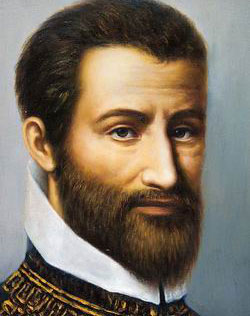 |
| Palestrina |
For this particular period I chose the model composer of the music of the Counter-Reformation, Giovanni Pierluigi da Palestrina (ca. 1525 - 1594). In order to achieve progress you need to sometimes take a step back, and Palestrina is the perfect example of that. Palestrina created an exemplary style of church music, a style upheld as a model during his lifetime as well as by succeeding generations, consciously imitated by later composers and officially sanctioned by the Church, and became the basis of the so-called stile antico (the "old style"). The treatment of both rhythm and harmony was completely controlled in Palestrina's music; nothing was allowed to disturb the smooth, continuous flow, and all dissonances (except suspensions) were carefully placed on unstressed beats. Whether long or short, the melodies unfolded in balancing curves, with barely large leaps that always contoured by a change of direction in the melodic line. The text settings was always reflecting the natural accentuation, but never in a immoderate way. The voice texture was very clear, and he achieved that by many ways, such as interlocking entries, antiphonal writing, reduction in the number of parts, invertible counterpoint and repetition of the material. In terms of progress he had to adapt his music to follow the new rules of the church, and still got to achieve a point where his writing was magnificent and didn't loose any of the pre-antecedent musical thoughts, he just did it in another way.
The music I choose to represent the Counter-Reformation style was Palestrina's Missa Papae Marcelli. This rather "free" Mass it's based on an original theme, in contrast with the practice in the past that would borrow a melodic theme from other music. I think that this Mass translates in perfection all of Palestrina compositions techniques, that was based of the style established by the Council of Trent. When listening to it, notice where we took voices out to clarify the texture, where he treated the shape of the melody to give emphasis on the text, and how the dissonances were carefully placed. Enjoy!